Featured Products
If you buy something from a link, 6 Months Later may earn a commission. See our ethics policy.


Meta – Starfire Kylie Edition AI Glasses


Related Posts
Meta Ray-Ban vs. Meta Glasses – Which Should You Buy?

Meta Ray-Ban (Gen 2) Smart Glasses Review – 6 Months Later

Meta Audio Glasses vs. Camera Glasses – Which Should You Buy?
Is there any argument you can make for camera glasses in 2026?
By Josh Teder
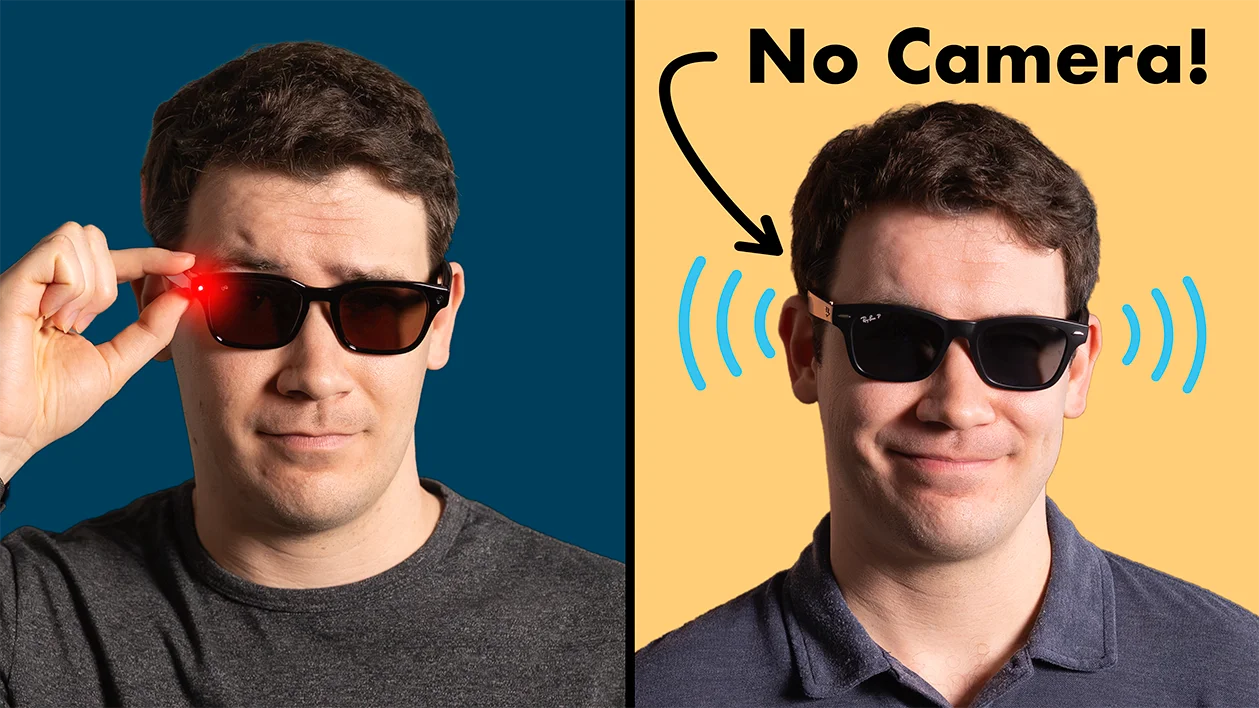
Unless you’ve been living under a rock for the past year, you’ve likely heard the term “pervert glasses.” This term has been everywhere in 2026, and it was given to Meta’s AI camera glasses after some users started to record people without their knowledge, which prompted a huge backlash toward these devices, at least here in the US.
But Meta just came out with a product that kind of solves that issue: the Ray-Ban Meta Audio, which completely removes the camera. But starting at $349, you’re still paying more for glasses that come with less. So, are the Ray-Ban Meta Audio worth buying? And what exactly do you get with Meta’s new audio glasses?

What You Get With the Ray-Ban Meta Audio
More Battery Life
Well, one, you get more battery life. That jumps up from 9 hours on the Ray-Ban Gen 3 to 12 hours with the audio glasses. And they still have plenty of juice in their case: 48 hours with the Ray-Ban Audio vs. 50 for the Ray-Ban Gen 3. Meta’s lower cost smart glasses, just named the Meta Glasses, like my Adventurer pair, only have 40 hours in their case.
| Glasses | Camera | Starting price | Glasses battery | Case battery |
|---|---|---|---|---|
| Ray-Ban Meta Audio | No | $349 | 12 hours | 48 hours |
| Ray-Ban Meta (Gen 3) | Yes | Check current price | 9 hours | 50 hours |
| Meta Glasses (Adventurer) | Yes | $249 | – | 40 hours |

If you’re weighing the Ray-Bans against Meta’s cheaper glasses more broadly, I covered that in my Meta Ray-Ban vs. Meta Glasses comparison.
Design Changes
And speaking of the case, the audio glasses also have a slightly different case color than the camera Ray-Ban glasses. So, if you own both, it is easier to tell them apart.

They also got new over-extension hinges like the Meta Glasses have, which make them a bit more comfortable to wear as well as more durable.

The audio glasses also have interchangeable nose pads, which is nice to see. Although, they are kind of a pain to switch out, and I much prefer the design that Meta put in the non Ray-Ban Meta Glasses.

Audio and Mics
All right, what about the audio? These still have the same great speakers that you get in Meta’s other glasses, and they sound nice. Nothing sounds overly harsh or bad. You’re not going to get a ton of bass or anything like you would with buds that create a seal in your ears, but on the flip side, these don’t put anything in your ears and allow you to hear the environment around you completely.
You can also enable spatial audio in settings, which just expands the soundstage a bit, as well as adaptive volume, where they’ll increase or decrease their volume based on your ambient environment. Overall, for glasses, these are pretty good.

But what about the mics? Well, Meta built a six mic array into these. These are really just meant to be used for phone calls. And related to mics, later this year, a new FDA-cleared hearing aid feature will be coming to Meta glasses.
Meta AI and Muse
And yes, they still have the Meta AI assistant on them, which you can trigger hands free with the wake word. Meta has improved the accuracy of the info that you get from the assistant and what you can do with it. Though mainly, I still use it to just play music. So, not having a camera on these for the Meta assistant specifically hasn’t really been that big of an issue for me.
Now, AI features have never really been the killer feature for these glasses, at least to me. However, I think that could start to change in the future. That’s because Meta is planning to bring Muse, its AI agent product, to the glasses.
Meta doing this, to me at least, is really interesting, because you’ll be able to ask Muse about projects it’s currently working on for you, or about past chats you’ve had with it, all right from the glasses. And Muse has the ability to just know way more about you, depending on what data you give it, of course, and how much you trust Meta with that data. A lot of caveats there, but I think that integration does at least have some potential.
AI features have never really been the killer feature for these glasses. However, I think that could start to change.
Media, Controls, and the LED
And then, of course, with the glasses, you can play specific music, podcasts, and media, text, or make calls. And they integrate with Meta’s own apps as well as third party ones.
For controls, while they don’t have a capture button, you still get an action button, which you can customize in the app to do different things like play music from Spotify or Apple Music, plus touch controls on the side. And you can customize the touchpad action in settings as well.

Now, there are a few smaller design differences to note besides no camera. One is Meta moved the LED light to the right arm, which at first makes you think you’re not going to be able to see it from the glasses. But when wearing them, you can actually see its reflection in the lens itself, which is nice.

So that’s the all-new Ray-Ban Meta Audio. You get, like, 80% of what you get in the camera glasses, with none of that feeling weird in public that I’ve certainly experienced earlier this year when wearing the new Meta glasses out and about.
You get, like, 80% of what you get in the camera glasses, with none of that feeling weird in public.
Is There Still a Case for Meta’s Camera Glasses?
Speaking of which, is there a case here at the end of 2026 to still get Meta’s camera glasses? I’d say yes, but I’d say it is way more limited than it was when I first reviewed the Meta Ray-Bans.
I think they’re still useful for content creation when you specifically need to get footage of doing something with that first-person viewpoint, where other cameras would be impractical. Especially now that Meta announced a new landscape crop mode coming to some of its glasses that will finally allow you to record in a regular horizontal mode.
If you’re mainly planning to wear them around home, or areas where you don’t have a lot of people out and about, like my family farm for example, then in those scenarios, I’d say go for it. These are still great for capturing things like your kids and pets, subjects that are notoriously difficult to get to look at a camera lens.
It’s just out in public, where you’re passing by a lot of people. That’s where I’ve not felt comfortable wearing the camera version of these glasses this year. Even though, yes, they have the recording lights, so people theoretically should be able to tell when they’re being recorded or not, I just don’t want to make people feel uncomfortable when wearing these, or have any potential negative interactions with people while wearing the camera version. That’s just me, though.
Price: Are the Ray-Ban Meta Audio Worth It?
There’s one more thing we need to talk about, and that’s price. The Ray-Ban Meta Audio glasses start at $349, which means they start above the $249 price of Meta’s own in-house camera glasses, which technically do more. But what you’re really paying for here is Ray-Ban glasses with speakers and a chip inside. And given that regular Wayfarer Ray-Bans start at around $180, you’re almost paying double for the Ray-Ban Meta Audio glasses.
Do these have enough to justify paying that much for them? Maybe. That depends on a couple of things. Number one, do you like open-ear earbuds? Or when you’re walking out and about, do you prefer something like the AirPods Pro 3 that have noise cancellation? If you prefer noise-cancelling buds, these are not going to be worth the money, at least to me.
But if you want to be able to hear your surroundings, and once Muse is on here, if you trust Meta, connect your contacts, calendar, and a bunch of other services to Muse and use the speakers for music and podcasts, yeah, that’s where I think these might be worth it.
I’ve linked all of the different styles of Ray-Ban Meta Audio glasses, as well as the camera glasses, in the Featured Products section of this post. You might see them on sale this holiday season, so definitely check out what they’re currently selling for.
Want more on smart glasses and wearables? See all of our Meta coverage.