iPhone 17 Pro Max Review – 6 Months Later
While technically impressive, is this really the iPhone most people should get?
By Josh Teder
The iPhone 17 Pro Max is the biggest, baddest iPhone Apple has ever made. But 6 Months Later, is this really the best iPhone to get? I’ll take you through that, plus some changes I’d like to see Apple make.
The Camera System
Apple has, for years, claimed that its camera systems are professional tools. You get allegedly six to eight lenses in your pocket. You could be the next Spielberg with this thing, even though Spielberg wouldn’t be caught dead using an iPhone over a traditional camera lens.
But this is the iPhone where even if you don’t use it as a pro tool in your business like I have, even if you don’t use Genlock or Apple Log or ProRes RAW for video, use the Final Cut Camera app to preview your LUTs and have way more control over the footage you’re shooting, even if you don’t use any of those pro features and you just want to take good photos and videos with your iPhone, yes, it does a fantastic job of doing that. You just get excellent image quality for a phone.
Not just with the main camera, though. I’ve been pretty blown away by the quality of that particular lens and sensor combo. Close-up shots look great, and in good lighting conditions, I genuinely struggle to tell if some of these shots came from an iPhone. In near total darkness, that’s where you’ll start to see the smaller sensor hit its limits and show noticeable noise.
Video quality continues to be outstanding. It’s crisp, has excellent color, and pretty low noise in all but the darkest conditions.
“Honestly, if somebody just forced me to only use a smartphone camera for all of my work and documenting life events, I’d be pretty okay with this camera system from Apple.”
For example, I went to our annual Chinese Lantern Festival this past holiday, and I was really impressed at how the camera performed. There’s a lot of dynamic range and intense colors coming from the LEDs and the lanterns, and the phone handled all of that pretty well. You can see how good the wide camera is in particular. Though when you switch to something like the ultrawide, it definitely doesn’t look as good, and the telephoto is a bit hit or miss.
This camera system, in particular, does really well with LED lights and smoke effects, something that’s pretty common for other smartphones to get wrong. Here it just looks right, capturing pretty much what the Downtown Cary Park looked like when it was lit up for Halloween last year.
For both of those events, because I knew there would be a lot of dynamic range, I did use the ProRAW mode. The reason I shoot in this mode in these situations is that it allows the camera system to capture more data that you can play around with in post. But straight out of the camera, which all of the photos you’ve seen are, these raw files just look amazing.
For the Halloween event footage, I should have used Apple Log or ProRes so the phone could capture more image data, but I just used the regular video mode. You can see that the videos don’t come out quite as clean as the photos. There’s a bit more noise and you also do get some light reflections in the lenses, but it’s not nearly as bad as what I’ve seen with the Pixel 10 Pro XL that I reviewed.
So am I happy with this camera system overall? Yes. I think it’s probably the best one Apple has ever shipped. Has it caused me to ditch all of my dedicated cameras to just shoot on my iPhone? No. While NASA may have sent this phone to space, I do think it’s telling that almost all of the jaw-dropping images that came out of the Artemis 2 mission were shot from Nikon cameras with really nice lenses. Part of this is because of the optical lens, but part of it is also because dedicated cameras typically have a larger image sensor, which can net you better low-light and higher resolution images. Put those two things together and that’s why you’ll still see me shooting with a dedicated camera.
As far as smartphone cameras go, though, I haven’t noticed this phone producing those kinds of bad, blown-out photos that iPhones have produced for me in the past. Plus, this iPhone got the new 18-megapixel Center Stage selfie camera, which can automatically crop your photo in and out depending on how many people are actually in your selfie, all without you having to change how you’re holding the phone. Pretty cool.
The A19 Pro Chip and Performance
In order to keep iPhones like this continuously recording video in various conditions, something many smartphones and even professional cameras struggle with due to overheating, you need a fast chip, but also one that cools efficiently. And that’s exactly what you get with the A19 Pro chip.
It’s the best performance you’ll get in any current iPhone, and it’s one of the best chips in any smartphone, thanks to not only its impressive single-core dominant performance, but its new cooling setup, which combines a vapor chamber with the new aluminum unibody chassis for far greater heat dissipation than previous iPhones had.
You can actually see how much of a difference that vapor chamber and aluminum chassis make when you benchmark this phone against the iPhone Air, which has the same A19 Pro chip, though with a slightly lower GPU core count and slower RAM. The Pro Max is noticeably better, especially for graphics and gaming tasks.
Have I utilized this phone to its fullest potential? No. And I doubt most people will even need this level of performance.
Battery Life
If you have a chip that is this high-performing and a camera system that can shoot high-quality footage for extended periods like this one, the next thing you’ll likely want is great battery life. And the iPhone 17 Pro Max definitely delivers there.
I’ve seen the battery level hit in the upper 60% to lower 70% range on normal days, meaning this phone can realistically last me two days on a single charge, and has multiple times throughout my six-month testing period. I’m a light to moderate phone user with one to 2.5 hours of screen time and one to two hours of background playback for music and podcasts on a typical day.
On heavier days, like when I was doing a lot of B-roll shooting or running a lot of graphics-intensive tasks, I’ve seen the battery get to around the mid-40% range by the end of the day.
Ceramic Shield 2 and the Display
Another highlight of this phone is Ceramic Shield 2. As I mentioned in my iPhone Air review, this glass is the reason I decided not to put a screen protector on this phone, and going forward, I probably won’t be putting one on any iPhone. Not only is this display harder and better against drops, but critically, in my case, it’s significantly more resistant to micro-scratches. 6 Months Later, like with the iPhone Air’s display, I haven’t noticed any micro-scratches or abrasions on this display. It also significantly reduces glare and reflections thanks to a new anti-reflective coating, making it way easier to see outside.
iOS
The last big highlight I’ve had using this iPhone is iOS. And of course, I’m talking about Liquid Glass. Just kidding. It’s fine, honestly, but it’s definitely a bit more form over function.
That said, iOS does have some real benefits, especially with this latest version. New phone call features have been genuinely useful. Being able to screen unknown callers or stay on hold has been really great. There are also just a lot of nice quality-of-life things that you get with iOS. Not only does it make things easy to integrate with other Apple products with features like AirDrop, AirPlay, continuity features, and so on, but even for smaller things like passwords or automatically pasting in verification codes. There are just a lot of little nice things that you miss when you’re not using iOS. And I really like Apple’s push to put search boxes at the bottom, closer to where your thumb actually is.
Another iOS benefit is that apps just run better on iOS than on Android in general. Plus, you often see apps launch first exclusively on iOS, like Acme Weather from the creators of Dark Sky or Google’s new AI Edge Eloquent app, which is kind of crazy given that Google runs Android.
What I Didn’t Use
Let’s talk about what I didn’t use with this phone. First up are most Apple Intelligence features. I do use notification summaries and especially priority notifications, which are actually pretty useful when I have a focus mode enabled. Visual Intelligence is another one I tried recently, but it was laughably bad. It couldn’t even identify the correct app being shown on Apple’s own website, and it was Apple’s own app.
Another thing I haven’t really used all that much is the speakers. In fact, they’re not as good as you might think. At higher volume, I hear audible distortion, just like I noticed with the iPhone Air’s top speaker, and that distortion overall was not present in my 16 Pro Max.
The Downsides
By far the biggest downside for this iPhone, and most iPhone Pro Maxes over the past few years, is weight. This Max is one of the heavier ones at 233 g, which puts it right in line with the Pixel 10 Pro XL, but it’s a good bit heavier than the new S26 Ultra that I’m reviewing, which comes in at 214 g.
Some of you are going to argue that my obsession with phone weight is stupid and that people prefer heavier phones because they feel more premium. For a device designed to be held in your hand for long periods of time to look at and scroll on, I think that’s just a crazy take. Like, nobody ever asked Steve Jobs, “Wow, that MacBook Air, it’s so light and thin. You know what I wish? I wish it were heavier, because then it would feel more premium.”
This does lead me to my second downside with this phone, which is that it is not the iPhone Air.
“6 Months Later, switching back and forth between these two phones has really made me want Apple to create a pro iPhone with the thinness and weight benefits that you get with the Air.”
That would make the Pro a bit more modular in a way. For everyday use, you’d have a lighter phone with all of the Pro cameras and features. And then for long shooting days, travel, or just heavier use, you could attach a battery pack to add that extra capacity. That would honestly be my ideal pro iPhone.
Another downside, or potential downside since I haven’t run into this one personally, is that the anodized aluminum finish can be scratched off, especially around the edges of the plateau. Because I’ve kept this phone in a case for almost the entire 6-month period, this isn’t really something I’ve personally noticed or had an issue with, even with the cosmic orange color that I got.
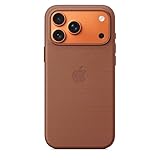
Speaking of cases: not a segue to a sponsor, but I absolutely love the material of Apple’s new tech-woven case. The case I got has held up really well and seems to hold up better than the fabric-woven cases that Google made for their Pixel line a few years back. Apple’s case is more grippy than those and I actually think it holds up better over time than the Apple silicone cases I got for previous iPhones.
Another downside is Siri. While in my experience it’s still great for playing music and setting timers, 6 Months Later, it’s increasingly felt dated as Gemini has not only gotten faster and more reliable, but also comes with expanded capabilities.
Another downside of this iPhone, and really all iPhones, is the App Store. It’s the only place you can download apps from, which inherently makes the iPhone less versatile than if you could download apps from the web like you can on the Mac.
The last downside with a Pro Max is price. I don’t think it should necessarily cost $1,200 to get a three-camera-lens iPhone. We should have an iPhone that has three camera lenses on it that isn’t necessarily a pro iPhone in 2026. You can check the current prices via our shop page, where we’ve got links to multiple retailers.
Should You Get the iPhone 17 Pro Max?
Is this the best iPhone you can get today? Technically, yes. But is it the one that everyone should get?
First, given we’re at the 6-month mark, if you can wait, it probably makes sense to hold out until September for new iPhones, or even the new iPhone Fold that Apple’s rumored to be working on for later this year. Keep an eye on this site for all the updates on that and more Apple coverage.
In general, yes, I do recommend the iPhone 17 Pro Max for a select group of people. You should get this phone if you want the biggest display in a current iPhone, a triple camera system on the back with all of the pro camera features, the A19 Pro chip with better sustained performance than the Air, the LiDAR sensor for scanning 3D objects and helping with virtual furniture placement (a highly underrated feature, by the way), and you want the best battery life and capacity of any current iPhone and can deal with the weight.
But if you don’t need all of that, or could compromise on one or two of those things, especially if you don’t need the pro camera features, if you already have a dedicated camera for important stuff like I do, but you still want a big-screen iPhone that feels great in your hand and is a joy to use, then I would actually look at getting the iPhone Air. It’s been my favorite iPhone to use over the past 6 months, even with the smaller battery and single camera on the back.
For more of my thoughts on how these two phones compare, check out my in-depth comparison of the 17 Pro Max and the iPhone Air. And for more 6 Months Later reviews, head over to my Pixel 10 Pro XL review or browse all our reviews at 6monthslater.net.