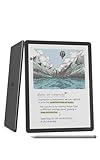
It’s been six months since I got the newest top-of-the-line Kindle Scribe, the Kindle Scribe Colorsoft, the first ever color Kindle in this size. But starting at $630, one thing it certainly is not is cheap.
So is the Kindle Scribe Colorsoft worth the money? Or would you be better off spending less on a different Kindle, or going with a competitor like reMarkable or Supernote? I’ll answer all of those questions, but first, let’s start with the one you probably already have in your head: how good is the color?
How Good Is the Color, Really?
I’d say it’s just okay. The colors on this display are muted and can look a little too close to one another, a problem I ran into a good bit when color coding my shot list. Blue and green look pretty close to one another with the highlighter. You can also see the filter used to create the colors if you get close up to the display, though given this is a tablet you generally hold farther away from your face than something like the Kindle Paperwhite, I don’t think that’s a deal breaker.
You can tell Amazon made some tradeoffs with this display technology. You get better responsiveness and less of the ghosting refresh effect you see on other devices like my reMarkable Paper Pro, but at the cost of color saturation. If you look at the orange on the Kindle Colorsoft, it just looks kind of flat. Not all the colors look blah, though: blue and yellow highlights, for example, look pretty solid.
If you’re thinking getting a Colorsoft version of your Kindle will immediately upgrade your reading experience and everything’s going to be in color, in my experience that has not actually been true. For Kindle books with images, the color version of those images isn’t always included in the book file. The John Williams biography I’ve been reading recently has images, some of which I know were originally shot in color, but they show up in black and white on the Kindle Scribe. Same thing for other books I’ve read, while book covers, interestingly, are typically all in color and look great.
“There is a chance that if you buy this and go back to your books with images, not all of them are going to be color images.”
So unless you just read comics or graphic novels, I don’t think this device is worth getting just for the color upgrade alone if you read books outside those two categories generally.
What Sets the Colorsoft Scribe Apart
That said, the Colorsoft Scribe does have a lot going for it, and one of the biggest strengths is something every Kindle Scribe has that the competition doesn’t: your books and your notes are all in one device. You don’t have to juggle a digital e-reader and a separate device for note-taking. Amazon’s family sharing feature is still one of the most underrated aspects of the Kindle ecosystem, too. You can easily share books with a spouse or your kids’ library without buying an additional copy. That’s genuinely useful.
The Writing Experience
Another standout feature is the writing experience, which carries over the best parts of the previous Kindle Scribes I’ve reviewed. The felt tip in the pen is still great, and the improved eraser they debuted with the last Kindle generation returns here as well. It feels more like a felt pen on paper than a pencil, which is how I’d describe the current generation of reMarkable devices, which I’ve also reviewed.
Another thing that sets the Premium Pen apart from others is that it doesn’t have a battery, so you never need to charge it. It also rolls farther on a smooth surface than the previous generation, by quite a bit, though it is weighted in a way where it does try to slow down a bit, at least.
Another design win with books and notes that I really like and find useful is the shortcut back to your most recent notebook or book along the bottom shelf, which makes it easy to dive right back into a notebook you were working on.
Color Tools and Navigation
One of my favorite writing features is the multiple color switcher they implemented with the Colorsoft. Each pen tool shortcut has two color slots that you can change, making it really fast to switch back and forth between pens and colors. The selection tool also works really well, and here there’s a new Colorsoft-specific addition: you can change your selection’s color. The last writing tool I found really useful is the ability to drag out shapes, which is great if you’re making diagrams, business process maps, and so on.
Another thing that’s really impressed me with the Colorsoft is the refresh speed. Navigation, adjusting brightness, even loading web pages, an activity that almost never worked on any previous Kindle I owned, now surprisingly works, though you’ll probably still never use it. The point is everything feels faster and snappier than my previous Kindle Scribe.
Reading Features
The reading experience is also strong. You get annotation tools right in the text, different color highlights using the same pen tools from the notebooks, and a gallery view that lets you see nine-page previews at once, which is really useful for jumping around in a book to find a specific page. Then, of course, there are your other Kindle features like bookmarks, search, Wikipedia integration, and Dictionary X-Ray, which is especially important for George R.R. Martin titles and questions like, “Wait, which Aegon Targaryen is this again?” If you’re picking up a book again, it’ll auto-generate recaps to refresh your memory of what’s happened.
Have I found myself using the book highlights and annotations as much? Yes and no. I’ll definitely use handwritten annotations for some of my books, like my book on writing, because there are examples and ideas I want to jot down right there in the margins to help solidify my thinking. But because I read on both my Scribe and Kindle Paperwhite, which I’ve also reviewed, I mainly stick to highlights, underlines, and notes since those sync across Kindle devices. Handwritten annotations don’t even show up on the Paperwhite or other smaller Kindles.
Battery Life, Design, and Setup
As you’d expect from any Kindle, thanks to that e-ink display, the battery life is excellent. Amazon rates this for 8 weeks on a single charge with light use, which lines up with exactly my experience of about 2 months on a charge, or a bit more if you’re not using it every day, though that’ll drop if you’re doing a lot of heavy note-taking during the day.
Design-wise, Amazon brought back the black bezels, which I think was the right call compared to the weird white border on the previous Scribe. That always bothered me because the Kindle displays are always quite a bit dimmer than reMarkable devices, and seeing the white border around it made that way more clear. The build quality for a $630 device overall does feel premium, especially with the metal back. I also really like the new Executive Folio Cover made for this. It has a flap that snaps on easily and actually keeps the pen in place.
The last thing that stood out with the Scribe Colorsoft is the setup experience. It’s really fast, especially if you order the device via Amazon and check the Simple Setup option. Doing that will instantly link your device to your Amazon account and give the device your Wi-Fi network info, making setup even faster, something the competition definitely doesn’t match.
The Downsides
Price and Accessories
First and most obvious: price. $630 is a lot to ask for a note-taking e-reader, and it gets worse when you look at the accessories. The old Scribe covers used to start at $59 for a fabric folio. With this generation, the entry point is $89 for a plant-based leather cover, and the Premium Executive Leather Folio is $139. Ouch.
And while the tablet and the case genuinely feel premium, the Premium Pen itself doesn’t quite match that. With this finish, it just feels kind of plasticky rather than a nice, refined pen tool.
Display and Software Gaps
Another downside I ran into is with the auto-brightness. It can just go haywire when you’re writing near the top of the screen, and this happened enough times that I turned the feature off entirely. The display is also less reflective than on competing devices, so you’ll often find yourself turning the backlight on, and when you do, it can feel more like you’re writing on a screen than on paper. That’s really apparent when I have the Colorsoft sitting next to my reMarkable Paper Pro.
“It can feel more like you’re writing on a screen than on paper, and that’s really apparent next to the reMarkable Paper Pro.”
The screen gap between the glass and the display is also worse than what reMarkable is doing, though it looks a bit better than on previous Kindle Scribes I’ve used. And while I’m on the subject of reMarkable, I still think that company, and Supernote as well, do a better job with the actual notetaking software. Things like Infinite Scroll on reMarkable, so you can keep writing on a single page without hitting the bottom. They have better tap-to-undo and redo shortcuts, a two-finger slide gesture to write in the margin, plus layers. None of that is on the Scribe. You also can’t add to your notes from the desktop or mobile Kindle app; it’s basically a read-only experience if you’re not on your Scribe.
Power Button Placement
Another small downside I still haven’t gotten used to, six months later: they put the power button next to the pen. On a certain level I understand why: you’re going to grab the pen, so you can easily power it on there. If you’re using the cover all the time and just opening it up, it automatically turns on anyway, so it’s not a big deal. But if you have it out on your desk a lot, as I do, it’s just so inconsistent with where the power button typically is on devices of this size, like iPads or other e-ink writing devices, that it kind of drives me nuts.
Amazon’s DRM Problem
Another downside is Amazon’s book ecosystem. The Digital Rights Management, or DRM, situation is just a mess. It should be possible to protect copyright holders while still letting users move digital books they paid for to a different e-reading device. But in 2026, if you buy a book on Amazon, you’re basically only going to be able to read it on an Amazon e-reader.
People get around this issue by using third-party software to remove the DRM and convert the ebook file into a format other e-readers can read. But stripping away the DRM is illegal under the Digital Millennium Copyright Act, otherwise known as the DMCA, here in the United States, and it’s also illegal in other countries and regions. So basically, if you buy ebooks from Amazon, remember, you’re buying a license to read that book. You don’t actually own it, and you can’t easily move that ebook file to another e-reader legally unless it’s an e-reader made by Amazon.
Who Should Buy the Kindle Scribe Colorsoft?
So, keeping all of that in mind, is the Kindle Scribe Colorsoft worth it?
If you’re an illustrator or artist who wants to draw on a Kindle, I think most people will prefer the Colorsoft version, even if the color saturation isn’t perfect. If you’re a comic book or graphic novel reader who’s already tied into the Amazon ecosystem, the Colorsoft experience is definitely better than black and white.
But the question for those readers is whether this experience surpasses reading comics and graphic novels on an iPad. It depends on where you’re reading. On the beach in direct sunlight, the Colorsoft will likely still win, plus it has better battery life.
But if you’re mainly planning to read comics and graphic novels indoors, for the money, the iPad is just going to look way better.
Would I Buy One?
If I wasn’t reviewing this device, would I spend $630 on it? Probably not. Outside of color coding my shot lists and enjoying colored highlights in books, I don’t really need the color, and for pure note-taking I still prefer reMarkable’s experience.
But if you don’t care about the color, want a Kindle, and like the idea of a larger Kindle size, you can find refurbished last-gen models on sale for around $300, which is what I’d recommend instead.